
Marine Corps Launches AI Fellowship to Strengthen Workforce and Operational Innovation
MONTEREY, California | Feb 01, 2026
As the Department of the Navy expands the use of artificial intelligence across the Navy and Marine Corps, attention often centers on high-profile systems such as unmanned platforms and large-scale data networks. However, Marine Corps leaders say AI’s real strength lies in everyday applications that improve decision-making, automate routine processes, and support complex problem-solving at all levels of the force.
To advance this effort, the Marine Corps has introduced an AI fellowship at the Naval Postgraduate School (NPS) in Monterey, California. The program allows Marines to apply artificial intelligence directly to operational challenges, turning emerging technology into practical, data-driven solutions for the fleet.
Fellowship Aligns AI with Operational Needs
The AI fellowship supports the Marine Corps’ broader implementation strategy and aligns with the 39th Commandant’s Planning Guidance. The initiative focuses on accelerating applied AI research while developing a skilled workforce capable of deploying AI responsibly.
Marine Corps Capt. Stephen Steckler, a member of the inaugural cohort and an NPS computer science graduate, said the fellowship showed him where AI could add real value.
“The goal isn’t to replace Marines,” Steckler said. “It’s to streamline existing processes so operators can focus on more complex problems.”
Program Structure and Timeline
Launched in August 2025, the fellowship brought together Marines for a five-month research sprint. Participants split their time between applied research and field experimentation, each working on a use case tied to real operational challenges.
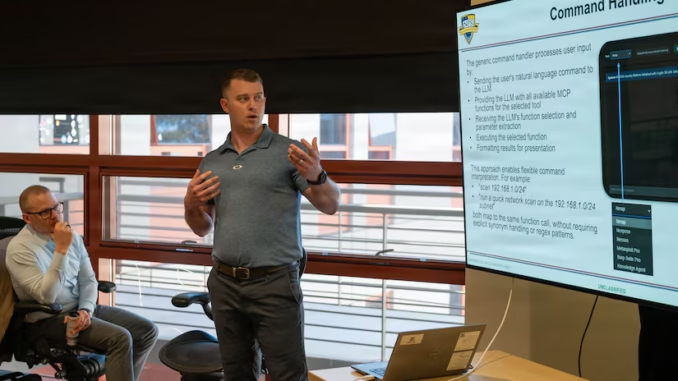
During the program, fellows received focused AI instruction and mentorship from NPS faculty and industry experts. In early 2026, the cohort returned to campus to present its findings to Marine Corps leaders, faculty members, students, and advisors.
Diverse Use Cases Demonstrate AI Potential
Christopher Paul, Marine Corps chairman for information at NPS and program lead for the fellowship pilot, modeled the initiative after the Air Force Phantom Program at the Massachusetts Institute of Technology.
Paul said the fellowship combines operational experience with technical expertise, enabling Marines to address real-world problems using AI tools.
One fellow, Cpl. Joe Sadler at Camp Pendleton, is developing a large language model-based tool to reduce paperwork in a battalion maintenance facility. By automating administrative tasks, the system could save time and allow Marines to focus on core maintenance work.
AI Improves Cybersecurity Testing
Steckler’s project focused on cybersecurity testing at the Marine Corps Operational Test and Evaluation Activity. His team explored edge-deployed large language models to automate parts of cyber operational testing in classified, air-gapped environments.
The system integrates existing commercial security tools into a single, natural-language interface. As a result, it reduces analyst workload and shortens training time. The project achieved an overall accuracy rate of 93.3%, showing strong potential to cut testing timelines and personnel demands.
Paul noted that AI can automate routine vulnerability testing, allowing analysts to spend more time identifying creative attack methods before equipment reaches the field.
Building the AI Workforce
While the fellowship delivers tangible prototypes, Marine Corps leaders stress that workforce development remains a central goal. Steckler said the experience offered valuable lessons for future participants, particularly the importance of defining problems clearly and securing critical resources early.
Programs such as the Marine Corps Software Factory provide a parallel pathway to move these research projects beyond academia. While fellows focus on research and prototyping, the software factory helps convert successful concepts into production-ready tools for operational use.
From Research to Deployment
Marine Corps Col. Pedro Ortiz, software factory liaison officer for AI and emerging technology, said the projects demonstrate how Marines can apply AI at their own level.
Ortiz, a graduate of the Marine Corps doctorate technical program at NPS, said the fellowship could eventually feed production-level software across the force through the software factory.
Looking Ahead
Marine Corps leaders emphasize that AI must support Marines rather than replace them. As AI adoption accelerates, they continue to balance speed with risk while maintaining strong governance.
Paul highlighted the diversity of the inaugural cohort, which included officers, enlisted Marines, and civilian government employees.
As the second cohort begins, the Marine Corps is exploring the creation of a center for digital transformation. The proposed hub would support AI knowledge sharing, prototyping, and collaboration with academia, industry, and federally funded research centers.
NEWS DESK
PRESS UPDATE