
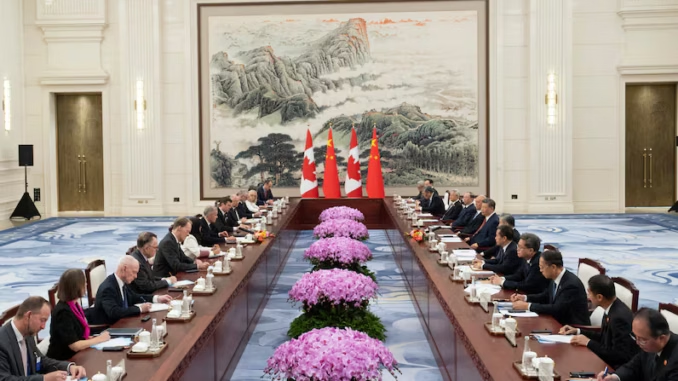
Canadian Prime Minister Mark Carney has reached another trade agreement with China, aiming to improve market access and provide relief to Canadian industries that have faced prolonged tariffs and regulatory obstacles. However, the agreement has also raised concerns over the concessions Ottawa may have made to secure closer economic cooperation.
China’s history of diplomatic tensions with Canada continues to cast a shadow over the renewed partnership. Beijing previously detained two Canadian citizens during the dispute surrounding Huawei executive Meng Wanzhou. Furthermore, Canada’s 2024 foreign interference inquiry identified China as the most active source of foreign interference in the country.
Carney had previously described China as Canada’s biggest national security threat during an election debate. His government also introduced a foreign influence registry to address interference by Beijing and other foreign actors.
Despite these concerns, the Prime Minister has adopted a more pragmatic approach towards China, particularly as Canada’s economic relationship with the United States faces growing uncertainty. The Trump administration’s tariffs on Canadian goods have placed considerable pressure on several domestic industries, encouraging Ottawa to explore alternative trading partnerships.
Following his meeting with Chinese President Xi Jinping on Tuesday, the Prime Minister’s Office announced that both countries had agreed to strengthen their bilateral relationship. Officials maintained that renewed cooperation would bring advantages to citizens on both sides.
Nevertheless, former Canadian diplomat Michael Kovrig has expressed serious reservations about the improving relationship. Kovrig, who was among the two Canadians detained in China, believes diplomatic relations have improved but warns that they should not yet be considered normal.
He acknowledges that closer economic engagement could generate valuable opportunities for Canadian businesses. However, he cautions that these benefits must not expose Canada to greater political, economic or security risks.
Kovrig also highlighted China’s previous use of trade restrictions against Canadian agricultural producers as a means of political pressure. He argued that discussions with Beijing should address broader concerns, including human rights violations, national security, transnational repression and Canadians detained in China.
Moreover, Canada’s decision to welcome additional Chinese imports, particularly electric vehicles and steel products, could create friction with Washington. Such developments risk complicating Canada’s relationship with its largest economic partner at a time when trade stability with the United States remains critically important.
Ultimately, Carney faces a difficult diplomatic balancing act: securing economic opportunities through renewed engagement with China while protecting Canada’s national security interests and preserving its crucial relationship with the United States.
NEWS DESK
PRESS UPDATE