
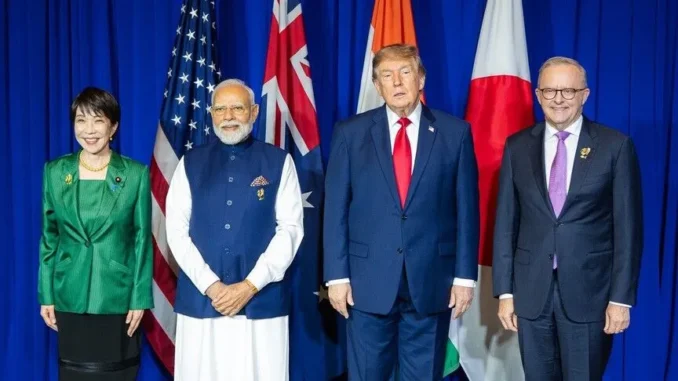
The Quadrilateral Security Dialogue (Quad), comprising the United States, Japan, India and Australia, has expressed serious concerns over arbitrary export restrictions and actions that could destabilize regional security. The statement was issued during the group’s first leaders-level meeting in more than two years, held in Manila on Tuesday.
Although the joint declaration did not identify any particular country, its timing is significant as US President Donald Trump is preparing to visit China on Wednesday. The meeting brought together Trump, Australian Prime Minister Anthony Albanese, Indian Prime Minister Narendra Modi and Japanese Prime Minister Sanae Takaichi.
Discussions took place against the backdrop of rising tensions in the disputed South China Sea and growing international competition to secure reliable supplies of critical minerals.
In their joint statement, the four leaders rejected unilateral measures, particularly those involving military force or economic pressure, that could alter existing regional arrangements. They warned that such actions could intensify tensions and threaten peace and stability across the Indo-Pacific.
The leaders also criticized the use of economic coercion, expressing particular concern about unpredictable export restrictions that could disrupt international trade and supply chains.
Furthermore, the Quad reaffirmed its strong commitment to the unity and central role of the Association of Southeast Asian Nations (ASEAN). The grouping emphasized the importance of maintaining a free, open and stable Indo-Pacific region through cooperation with regional partners.
The meeting also highlighted the growing importance of advanced technologies, particularly artificial intelligence. The four countries pledged to strengthen cooperation in critical supply chains, maritime security, freedom of navigation and the responsible deployment of emerging technologies.
Special attention was given to the AI Accelerator, an initiative introduced by senior Quad diplomats in Atlanta. The programme aims to coordinate financial and technical assistance while expanding reliable access to artificial intelligence technologies across the Indo-Pacific.
The leaders also committed to maintaining secure maritime transport routes and improving cooperation with regional countries to address shared security and economic challenges.
As the Quad approaches the tenth anniversary of its revival, the leaders announced plans to establish an inaugural Quad Business Leaders’ Forum in early 2027. The platform is expected to strengthen commercial partnerships and encourage investment among participating countries.
Additionally, they welcomed the launch of the Indo-Pacific Maritime Surveillance Collaboration, an initiative designed to improve information exchange and strengthen regional maritime monitoring capabilities.
The four countries also announced plans for their P-8 and P-3C maritime patrol aircraft to participate in a joint exercise for the first time under the Quad framework in 2027. The initiative aims to improve maritime awareness and contribute to safer regional waters.
The Manila gathering was particularly significant because it marked Donald Trump’s first participation in a leaders-level Quad summit during his two presidential terms. Although the Philippines is not a member of the grouping, it hosted the meeting alongside the ASEAN summit.
Originally established in 2007, the Quad emerged from humanitarian cooperation following the devastating Indian Ocean tsunami in 2004. Over time, it developed into a strategic partnership focused on promoting an inclusive, secure and resilient Indo-Pacific.
Australia is scheduled to assume the Quad’s rotating chairmanship in 2027, continuing efforts to strengthen cooperation among the four member countries.
NEWS DESK
PRESS UPDATE