
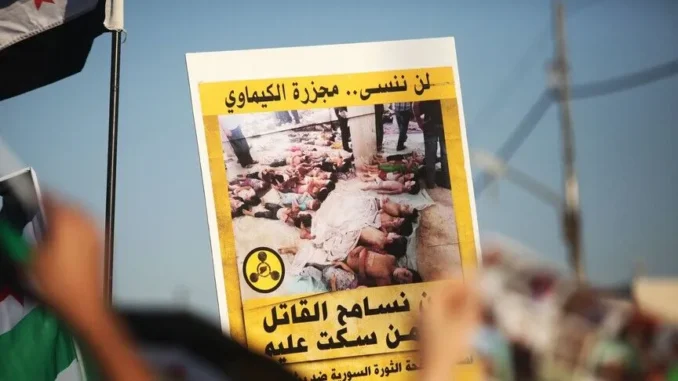
Thirteen years after the devastating chemical attack on Syria’s Ghouta region, survivors, medical workers and human rights activists continue to seek justice and answers in a country that has undergone major political changes.
The attack took place before dawn on Aug. 21, 2013, when rockets carrying the nerve agent sarin struck areas in the Damascus suburbs of Eastern Ghouta. The United Nations later described the incident as the most serious use of weapons of mass destruction in the 21st century.
Syria has changed significantly since the attack. Bashar al-Assad’s government collapsed in December 2024, bringing an end to decades of Baath Party rule. Since then, arrests, legal proceedings and new investigations have increased hopes that those responsible for past abuses could eventually face accountability.
For years, survivors and activists were unable to speak openly because of fear of government retaliation. They are now sharing their experiences and demanding justice for the victims.
Dr. Salim Namour, who was working as a doctor in Eastern Ghouta when the attack occurred, remains deeply affected by what he witnessed. He later helped establish and worked as a surgeon at Al-Kahf, an underground field hospital featured in the Oscar-nominated documentary The Cave. He now leads the Association of Victims of Chemical Weapons.
Namour recalled receiving an emergency alert around 1 a.m. after sarin-filled rockets struck neighborhoods in Zamalka and Ain Tarma. Medical teams and paramedics immediately rushed to hospitals to treat the victims.
He described an overwhelming scene in which hospitals received dozens and eventually hundreds of casualties. Some victims had already died, while others arrived suffering severe convulsions, difficulty breathing and other symptoms associated with exposure to the nerve agent.
The Syrian Network for Human Rights has recorded 1,144 deaths from the Aug. 21 attack, including 194 women and 99 children.
A UN investigation at the time found what then-Secretary-General Ban Ki-moon described as clear and convincing evidence that sarin had been used on a significant scale. The attack was also characterized as a war crime.
Namour said the memories of that night continue to cause him emotional pain. Even years later, recalling the suffering he witnessed can leave him unable to speak because of his emotions.
Ghouta was the deadliest chemical attack during Syria’s civil war, but it was not an isolated incident. UN and Organization for the Prohibition of Chemical Weapons investigators documented numerous other chemical attacks during the conflict.
Among them were the 2017 sarin attack in Khan Shaykhun and the 2018 chlorine attack in Douma, another area of Eastern Ghouta, which killed more than 40 people.
The Syrian Network for Human Rights has documented more than 200 chemical weapons incidents throughout the Syrian civil war, leaving survivors and victims’ families continuing to demand accountability many years later.
NEWS DESK
PRESS UPDATE