
A groundbreaking study by University of Oxford scientists suggests that Earth may have had the necessary ingredients to form water from the very beginning—challenging the widely accepted theory that water arrived via asteroid impacts.
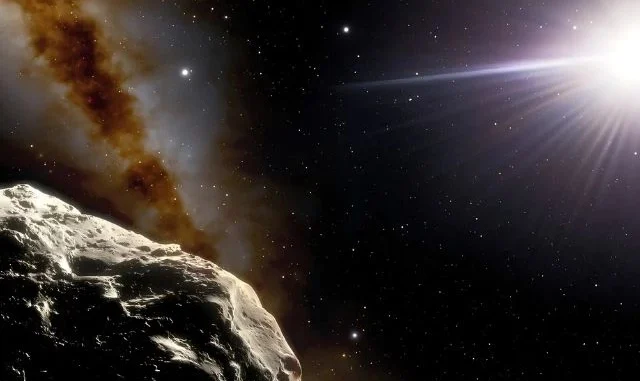
Published in the journal Icarus, the research focused on an ancient meteorite known as an enstatite chondrite, dating back 4.6 billion years. The study found that the hydrogen within the meteorite was largely native, not the result of later contamination. This supports the theory that Earth’s original building blocks were already rich in hydrogen—an essential component for forming water.
“We previously believed Earth gained its water from lucky asteroid impacts,” said lead author Tom Barrett, a doctoral researcher in Oxford’s Department of Earth Sciences. “But our findings suggest the materials that formed Earth already contained significant amounts of hydrogen and oxygen. That means Earth could have been wet from its earliest formation.”
To uncover these findings, researchers used advanced X-ray Absorption Near Edge Structure (XANES) spectroscopy, requiring a particle accelerator for precise analysis.
While the study reshapes the understanding of Earth’s early development, Barrett noted that it doesn’t necessarily imply life could have begun sooner. “Habitability depends more on how a planet evolves than just on its starting materials,” he explained.
James Bryson, co-author and associate professor at Oxford, added that the discovery strengthens the theory that Earth’s water could have formed naturally from its original composition, not solely through external cosmic events.
However, some experts remain cautious. Matt Genge, a planetary scientist at Imperial College London, raised concerns about possible contamination since the meteorite was found in Antarctica and may have absorbed Earth’s moisture. Bryson acknowledged this but emphasized the research team’s efforts to minimize such interference, estimating only about 15% of the hydrogen was Earth-derived.
The study marks a significant shift in the conversation around Earth’s formation and opens new avenues for understanding the origins of planetary water across the solar system.
NEWS DESK
PRESS UPDATE