
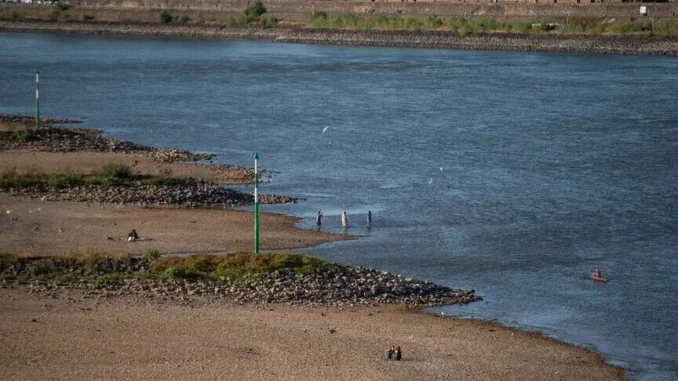
Europe is facing an increasingly severe drought as prolonged rainfall shortages and extreme temperatures continue to reduce river levels, damage crops and disrupt energy and transport systems across the continent.
Recent findings from the European Commission’s Joint Research Centre showed that drought conditions remained critical across much of Europe in July, with the situation worsening in several central and western countries, including France, Germany, Hungary, Austria, the Czech Republic and Slovakia.
Major rivers such as the Rhine, Loire, Po, Danube and Tisza have experienced exceptionally low water levels. The decline is disrupting the movement of goods, fuel deliveries, agricultural irrigation and electricity production.
Germany has been particularly affected by low levels on the Rhine, which carries a large share of the country’s inland freight. Near Kaub, vessels are unable to operate with their usual cargo loads, creating major difficulties for freight companies. Similar problems have affected eastern France, where reduced river capacity has limited the amount of fuel that can be transported to Strasbourg.
France is also experiencing shortages at some fuel stations, while several areas have introduced strict water restrictions because rainfall has failed to improve drought conditions. In some locations, authorities have imposed the highest emergency classification, limiting water consumption mainly to essential purposes.
Northern Italy is facing serious problems in the Po River basin. Severe drought has been recorded at almost all monitoring stations, while some locations have reached extreme levels. In Lomellina, an important rice-producing region, farmers are receiving irrigation water according to scheduled rotations, with agricultural losses potentially exceeding €100 million.
The reduced flow of freshwater into the Po Delta has also allowed seawater from the Adriatic to move further inland, increasing the risk that river water will become unsuitable for agricultural irrigation.
The Danube is suffering from similarly severe conditions. In Budapest, water levels dropped to record lows in early August, exposing large parts of the riverbed and even previously hidden objects. Some sections near Szentendre became shallow enough for people to cross on foot, while thousands of households temporarily experienced problems with their drinking-water supply.
Low water levels are also creating concerns for Hungary’s Paks nuclear power plant, which depends on the Danube for cooling and supplies a significant share of the country’s electricity. Authorities have taken emergency measures to maintain sufficient water levels near the facility and prevent further reductions in power generation.
Romania is also experiencing a sharp decline in Danube water flow. Measurements at Bazias fell to roughly one-third of the river’s usual August average, with officials warning that levels could decline even further.
Why Is Europe Facing Such Severe Drought
Scientists say the current crisis results from the combination of two connected factors: insufficient rainfall and prolonged extreme heat.
Persistent high-pressure systems during the winter and early spring prevented Atlantic weather systems from bringing adequate rainfall to several parts of central and northern Europe. From April onward, the high-pressure pattern expanded westward, further blocking rain-bearing systems from reaching countries such as France, Spain and northern Italy.
The situation became more severe in June when exceptionally warm air moved north from southern Europe. Clear skies and extreme temperatures increased evaporation and caused greater moisture loss from soil and vegetation.
Dry soil then absorbed more heat, creating a cycle in which rising temperatures accelerated further water loss. What initially began as a lack of rainfall developed into agricultural drought and eventually into hydrological drought, reducing water levels in rivers, lakes and groundwater reserves.
Researchers have found that soil-moisture deficits similar to those recorded in 2026 are now considerably more likely because of climate change.
Wider Economic And Agricultural Impact
Agriculture is among the sectors suffering the greatest immediate consequences. The Joint Research Centre lowered its forecasts for winter crop production and reduced expectations for grain maize and sunflower harvests.
France is facing one of its weakest maize harvests in decades, while Romania has reportedly lost more than one million hectares of maize cultivation. Several agricultural regions across France, the Czech Republic, Slovakia, Hungary and Romania are particularly affected, while Germany, Spain and Italy are also facing weaker harvest expectations.
Low river levels are simultaneously increasing transportation costs and creating challenges for electricity production. Nuclear and thermal power plants require sufficient river water for cooling, while hydropower facilities depend on adequate water supplies.
During a heat wave in June, several nuclear reactors in France were temporarily shut down or operated at reduced capacity because river temperatures were too high or water flows were insufficient.
The economic consequences could also be substantial. Triodos Bank estimates that drought and extreme heat could reduce the European Union’s economic output by about 1% in 2026, representing approximately €180 billion. Such losses could eliminate much of the economic growth expected by the European Commission for the year, while declining worker productivity caused by extreme heat could itself represent a significant reduction in EU GDP.
NEWS DESK
PRESS UPDATE