
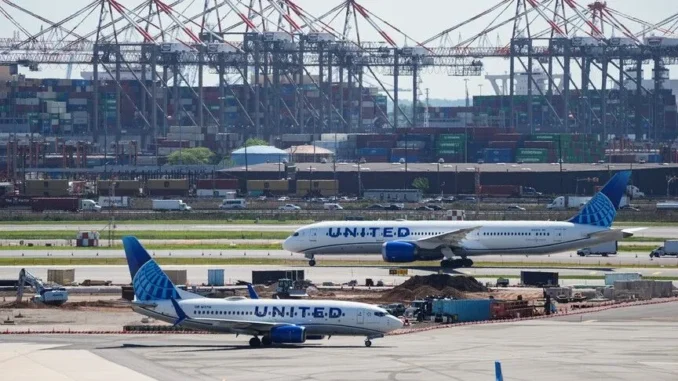
The US air traffic control network remained operational and stable on Saturday following a nationwide disruption. However, airlines were preparing to cancel thousands of additional flights while authorities investigated whether the incident resulted from a technical malfunction or an error during maintenance work.
Federal Aviation Administration (FAA) Administrator Bryan Bedford confirmed the system’s stability during a joint press conference with Transportation Secretary Sean Duffy. He said airlines were gradually restoring their operations after Friday’s nationwide ground stop.
According to Bedford, airlines were expected to cancel between 4,000 and 5,000 flights out of approximately 41,000 scheduled departures on Saturday. The cancellations were necessary to reorganize aircraft and crews that had been left stranded by the previous day’s disruption.
He expressed confidence that the situation would gradually improve, with airlines expected to resume their complete flight schedules by the end of Sunday. However, he acknowledged that considerable recovery work remained.
Bedford explained that approximately 50,000 flights had been scheduled for Friday. Around 30,000 had either completed their journeys or were already airborne when the FAA ordered a nationwide ground stop at approximately 3:45 pm Eastern Time.
During the four-hour interruption, authorities managed to restore around 8,000 of the remaining 20,000 flights. However, approximately 12,000 flights could not be accommodated, including 9,000 commercial services and 3,000 general aviation operations.
The FAA administrator revealed that technical instability had affected 17 of the agency’s 22 en-route air traffic control centres. The problems also extended to radar operations and communication networks.
Although none of the facilities experienced a complete shutdown, authorities decided to suspend nationwide operations as a precaution after spending approximately 45 minutes attempting to identify the source of the problem.
Transportation Secretary Sean Duffy said preliminary findings suggested that the disruption began during routine maintenance conducted by FAA contractor L3Harris at a remote facility. The maintenance involved replacing outdated copper telecommunications cables with modern fibre-optic connections.
L3Harris, which has provided services to the FAA for more than two decades, operates the agency’s older telecommunications infrastructure, Duffy explained.
During the maintenance operation, a router reportedly generated more than 1,000 connection requests every four to five seconds, overwhelming other routers and interfering with aircraft communications and radar information.
Investigators are examining whether the malfunction was caused by human error, incorrect installation or system configuration, or defective hardware. However, officials have not yet established the precise cause.
Duffy confirmed that normal operations resumed after technicians isolated the maintenance activity responsible for the disruption.
No Evidence Of Cyberattack
Both officials dismissed suggestions that the nationwide outage was linked to a cyberattack or artificial intelligence-related technology.
Bedford stated that investigators had found no indication of malicious activity or AI involvement in the incident.
Duffy also rejected claims that the FAA’s recently introduced Smart system, which assists in managing weather conditions and aircraft flight paths, had contributed to the disruption.
The transportation secretary used the incident to highlight the urgent need for modernizing America’s outdated air traffic control infrastructure. He called on Congress to provide additional financial support to accelerate technological improvements.
He revealed that approximately 69% of the FAA’s copper-based communications network had already been upgraded to fibre-optic technology. Nevertheless, substantial investment would still be required to replace the remaining outdated infrastructure.
Bedford confirmed that the agency had received $12.5 billion for modernization efforts, while Duffy announced plans to present a broader funding proposal to Congress on Monday.
The FAA administrator warned that technical failures could continue occurring until the country’s ageing telecommunications network was fully replaced.
He also apologized to passengers affected by the disruption, explaining that airlines were making arrangements to accommodate stranded travellers or issue refunds where necessary.
Meanwhile, Duffy confirmed that investigations would continue to establish the exact cause of the incident and determine whether L3Harris or an equipment manufacturer should be held accountable.
NEWS DESK
PRESS UPDATE