
India and Canada Rebuild Relations with Landmark Nuclear Energy Agreement
India and Canada have announced several new agreements, including a major 10-year nuclear energy deal, as both nations move to restore relations following a period of diplomatic tension.
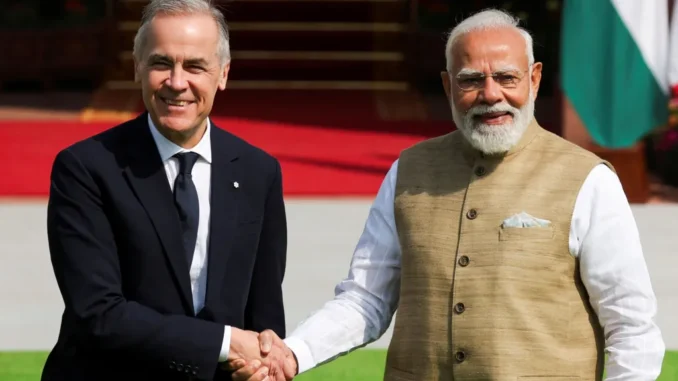
Prime Minister Narendra Modi met Canadian Prime Minister Mark Carney in New Delhi, where the two leaders agreed to strengthen cooperation in multiple sectors. Their discussions covered technology, critical minerals, space, defence, and education.
In addition, both governments confirmed plans to conclude a long-discussed free trade agreement by the end of 2026. Officials say the deal would help both countries reduce exposure to punitive tariffs imposed by the United States.
Efforts to Repair Diplomatic Relations
Relations between the two countries deteriorated sharply after former Canadian Prime Minister Justin Trudeau alleged that Indian authorities were linked to the 2023 killing of Sikh separatist leader Hardeep Singh Nijjar in Canada. New Delhi strongly denied the accusation.
Following the dispute, both governments expelled diplomats and suspended visa services, bringing diplomatic and trade relations close to a halt. Canada is home to a large Indian diaspora, which added further sensitivity to the situation.
However, since taking office last year, Carney has worked to cautiously rebuild ties. His government has stated that it currently sees no evidence linking India to violent crimes or threats on Canadian soil.
Nevertheless, some Canadian lawmakers and members of the Sikh community continue to question that assessment.
Security Concerns Remain
Canada’s intelligence agency, the Canadian Security Intelligence Service, listed India last year among several countries accused of foreign interference and espionage in Canada. The list also included Russia, China, and Iran.
In a statement released on Monday, the agency said its assessment regarding foreign interference threats had not changed.
Meanwhile, Canadian Foreign Minister Anita Anand distanced herself from comments made by a senior official who suggested that India had ended foreign interference activities in Canada.
Speaking to reporters in New Delhi, Anand clarified that those remarks did not reflect her own views. However, she defended Canada’s decision to resume diplomatic engagement with India, saying dialogue remains essential for progress.
Expanding Economic and Energy Cooperation
During their meeting at Hyderabad House in Delhi, Modi highlighted the importance of the nuclear agreement. Under the deal, Canada will supply uranium to support India’s expanding nuclear energy sector. The two countries also plan to cooperate on small modular reactors and advanced nuclear technologies.
Furthermore, Modi described India and Canada as “natural partners” in technology and innovation. Both governments agreed to strengthen collaboration in artificial intelligence, supercomputing, semiconductors, and renewable energy. They also plan to jointly host a renewable energy summit.
Carney said Canada is well positioned to help meet India’s growing demand for nuclear fuel. He also announced the launch of a strategic energy partnership between the two countries.
Trade and Strategic Cooperation
The two leaders also discussed increasing bilateral trade. Modi stated that both countries aim to raise total trade to $50 billion in the coming years.
Carney expressed confidence that a comprehensive economic partnership agreement could finally be completed after more than 15 years of negotiations.
Analysts say both countries see renewed cooperation as a practical response to changing global economic conditions. India is seeking new trade partnerships to diversify its imports and reduce its reliance on Russian energy supplies. Meanwhile, Canada aims to expand trade opportunities and attract new investments.
Public Opinion and Diplomatic Outreach
Recent surveys suggest that many Canadians support rebuilding relations with India. A poll conducted by Angus Reid found that around half of Canadians believe now is the right time to restore ties.
Earlier on Monday, Carney also met India’s Foreign Minister Subrahmanyam Jaishankar to discuss future cooperation.
Carney began his four-day visit in Mumbai, where he met business leaders and government officials to encourage investment and trade. After completing his meetings in New Delhi, he plans to travel to Australia and Japan as part of Canada’s strategy to diversify trade partnerships and attract global investment.
NEWS DESK
PRESS UPDATE