
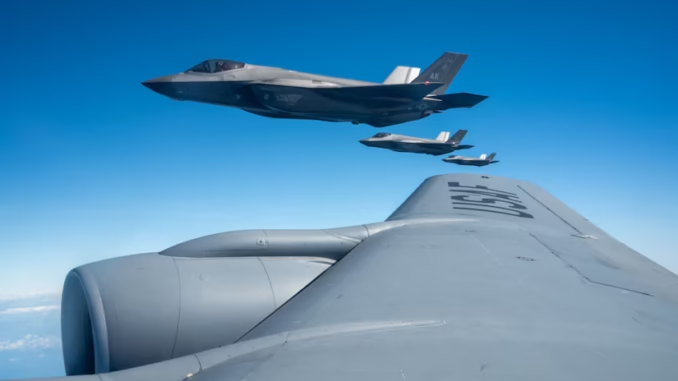
Air Force F-35As Strengthen High-Altitude Deterrence in the Pacific
Precision Power Takes Flight
F-35A Lightning II fighter jets thunder down the runway as heat ripples trail behind their engines, breaking the calm skies above the Pacific. This powerful display reflects the growing role of fifth-generation airpower in maintaining regional security.
At the center of this mission is the 356th Expeditionary Fighter Squadron, deployed from Eielson Air Force Base, Alaska, to Kadena Air Base, Japan, under the Air Force’s fighter rotation program. The squadron stands ready to defend allied airspace and respond swiftly to emerging threats.
“Our mission is to achieve air superiority whenever and wherever required,” said Maj. John Toner, the squadron’s deployed director of operations. “Each training sortie enhances our ability to deliver combat-ready airpower and maintain stability across the Pacific.”
Building Readiness Through Integration
The squadron develops its operational readiness through frequent joint training. It regularly conducts exercises with Marine Corps F-35B aircraft from Marine Corps Air Station Iwakuni, improving its ability to operate from alternate and forward locations.
In addition, the unit participates in major multinational exercises such as Keen Sword, which strengthen coordination between U.S. and Japanese forces while reinforcing the broader U.S.–Japan security alliance.
“These exercises help us operate as one unified force,” said Capt. Ryan Beveridge, an F-35 pilot. “Training alongside our allies builds trust, improves communication, and turns cooperation into real deterrence.”
Command and Control in the Air
The squadron also works closely with E-3 Sentry aircraft from the 961st Airborne Air Control Squadron. These platforms provide airborne command and control, allowing forces to coordinate operations across air, land, and sea domains.
Large-scale training events bring together U.S. Air Force and Japan Air Self-Defense Force aircraft in complex formations. As a result, allied forces sharpen their ability to respond quickly and decisively to regional challenges.
Support That Keeps Missions Moving
Behind every successful flight is the continuous support of the 18th Wing at Kadena Air Base. Its airmen provide logistics, infrastructure, and maintenance, enabling deployed squadrons to begin operations almost immediately upon arrival.
This seamless support ensures a steady and visible U.S. presence in the Indo-Pacific, reinforcing deterrence and reassurance for regional partners.
Advanced Capability, Strategic Advantage
As part of Pacific Air Forces, the 356th brings the advanced capabilities of the F-35A, a fifth-generation fighter built for contested environments. Its stealth design, integrated sensors, and electronic warfare systems allow pilots to detect threats earlier, share data faster, and act with precision.
“The F-35 is more than an aircraft,” Toner explained. “It connects our forces and multiplies their effectiveness across the theater.”
From Arctic Training to Pacific Operations
The squadron trains year-round in Alaska’s extreme climate, just south of the Arctic Circle. These demanding conditions build resilience, adaptability, and discipline—qualities that directly support deployed operations.
Moreover, Alaska’s strategic location allows rapid movement to the Pacific region, ensuring forces can deploy quickly when required.
“Deterrence at altitude depends on preparation,” Beveridge said. “Every mission we fly and every partner we train with sends a clear message of readiness.”
From Alaska’s frozen ranges to Okinawa’s tropical skies, the 356th Expeditionary Fighter Squadron continues to demonstrate the United States’ commitment to maintaining peace, stability, and security across the Indo-Pacific.