
MONTREAL — Canada and the European Union have established a new strategic partnership to strengthen economic security, defense collaboration and technological development. The agreement includes cooperation on critical minerals, artificial intelligence, digital commerce and energy.
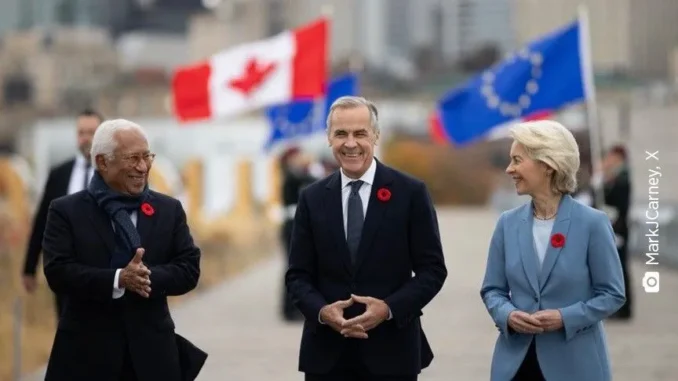
The announcement was made during the 21st Canada-EU Summit in Montreal, hosted by Canadian Prime Minister Mark Carney. European Council President Antonio Costa and European Commission President Ursula von der Leyen also attended the high-level meeting.
In a joint declaration, the leaders introduced the Canada-EU Alliance for the Future, an initiative intended to promote shared prosperity, improve economic security and develop stronger supply chains across both markets.
The partnership will prioritize reciprocal cooperation in strategic industries, allowing both sides to address common economic risks and strengthen their industrial capabilities.
Critical Minerals Energy and Economic Cooperation
Access to essential raw materials will be a major focus of the new partnership. Canada and the EU plan to increase investment throughout the critical minerals industry, covering extraction, processing, refining, manufacturing and recycling.
Both partners will also examine ways to secure supplies of strategically important resources, including potential stockpiling arrangements for materials required by civilian and defense industries.
Meanwhile, the European Investment Bank and Canada have completed negotiations on an agreement designed to encourage European investment in Canada’s critical minerals sector.
Energy cooperation will also expand, particularly through initiatives supporting liquefied natural gas exchanges, while remaining consistent with the partners’ climate commitments.
Digital Trade Artificial Intelligence and Education
Canada and the EU have concluded substantive negotiations on a digital trade agreement intended to modernize commercial regulations, improve legal certainty and facilitate international data transfers.
The two sides will also work to eliminate trade obstacles, improve regulatory coordination and establish development plans for strategically important industries. A new business council is expected to connect companies operating across both markets.
Artificial intelligence and digital infrastructure will represent another important area of cooperation. Planned initiatives include developing secure cloud systems, expanding computing capacity and strengthening collaboration involving data, AI models, software and digital applications.
In education and research, Canada and the EU intend to begin negotiations aimed at expanding Canada’s participation in Erasmus+, the European Union’s major education, training, youth and sports programme.
Associate Membership Proposal Left Out
The summit also took place amid discussions about establishing a closer institutional relationship between Canada and the EU.
European Commission President Ursula von der Leyen had previously suggested granting Canada associate membership, offering a deeper partnership without requiring full EU membership.
However, the proposal reportedly encountered opposition from several member states, with Germany among those resisting its inclusion in the summit’s final declaration.
NEWS DESK
PRESS UPDATE