
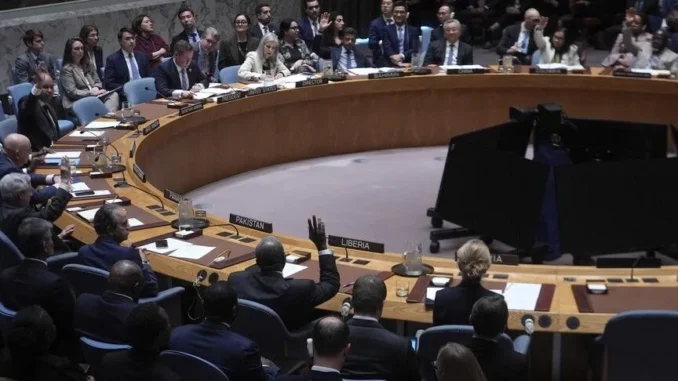
The UN Security Council on Friday approved a one-year extension of its support mission in Libya but failed to pass a US-sponsored resolution on Western Sahara after Russia exercised its veto.
The resolution concerning Libya, introduced by the United Kingdom, was adopted with 13 votes in favour and none against. Russia and Greece abstained from the vote.
The decision extends the mandate of the UN Support Mission in Libya (UNSMIL) and supports international efforts to help the country hold elections, reunify government institutions and establish a single executive authority.
The United States welcomed the decision, describing the situation as a “historic opportunity” for Libya. Washington emphasized the importance of forming a unified government and bringing the country’s security institutions under one authority. It also warned that individuals deliberately undermining the political transition could face consequences.
Russia supported the continued presence of UNSMIL but abstained, arguing that Libya’s political process should not be rushed or shaped by externally imposed solutions.
Russian Ambassador Vasily Nebenzya said agreements emerging from recent political discussions still required broader acceptance among Libya’s different stakeholders.
The Security Council subsequently considered a US-drafted resolution on Western Sahara. The proposal secured 11 votes in favour, three abstentions and one vote against. Russia’s opposition prevented its adoption through a veto.
The draft aimed to revise the UN’s approach to the decades-long dispute and encourage progress toward a political settlement. US Ambassador Mike Waltz argued that repeated attempts to organize a referendum had failed over several decades, making the continuation of the existing situation unacceptable.
Waltz said the United States remained committed to the principle of self-determination but believed it could be achieved through alternative approaches. He called on the parties involved to pursue a lasting political agreement.
Western Sahara remains a major point of disagreement in North African diplomacy. Morocco supports granting the territory extensive autonomy while keeping it under Moroccan sovereignty. In contrast, the Polisario Front demands a referendum on self-determination, a position backed by Algeria.
The dispute dates back to 1975, when Spain ended its colonial administration of Western Sahara. It subsequently developed into an armed conflict between Morocco and the Polisario Front, which continued until a ceasefire was reached in 1991.
NEWS DESK
PRESS UPDATE