
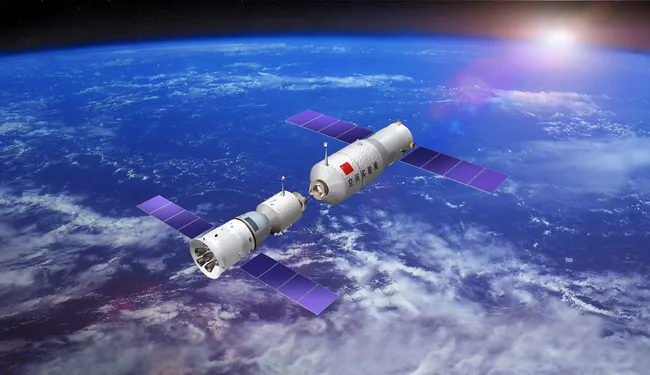
China successfully launched the Shenzhou-23 crewed spacecraft on Sunday, further strengthening the country’s growing ambitions in advanced space exploration and long-duration human spaceflight research.
The spacecraft lifted off from the Jiuquan Satellite Launch Center in northwestern China at 11:08 p.m. Beijing time. The mission is commanded by astronaut Zhu Yangzhu alongside crew members Zhang Zhiyuan and Li Jiaying. Chinese officials noted that one astronaut from Hong Kong joined the mission, becoming the first participant from the semi-autonomous region to take part in a Chinese crewed spaceflight.
A major focus of the mission involves a year-long orbital experiment designed to examine the physical and psychological effects of extended stays in space. Researchers believe the findings will contribute to improvements in astronaut healthcare systems, life-support technology, and operational planning for future deep-space expeditions.
The mission will also carry out scientific studies and technological testing aboard the Tiangong Space Station, including China’s first space-based human body research initiative. Chinese space officials described the experiment as a significant milestone in understanding human adaptation to prolonged space travel.
The launch comes as the current Tiangong crew nears completion of more than 200 days in orbit, approaching a national endurance record for continuous crewed spaceflight. China has rapidly expanded its space program in recent years, positioning Tiangong as a central hub for scientific innovation, lunar ambitions, and future deep-space exploration missions.
PRESS UPDATE