
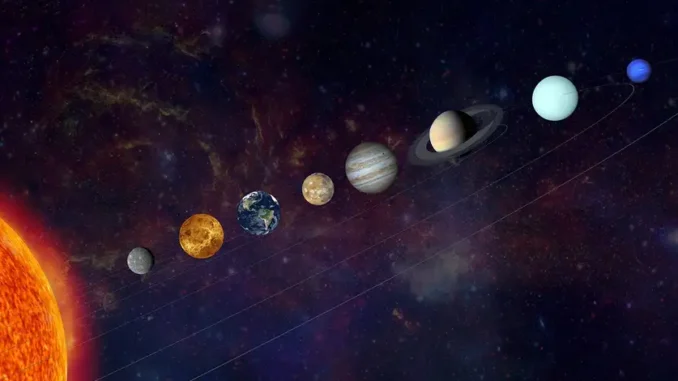
Catching all the solar system’s planets in a single night sky is a celestial treat that stargazers eagerly await. While rare, this astronomical alignment, known as a “planetary parade,” offers a stunning view of Mercury, Venus, Mars, Jupiter, Saturn, Uranus, and Neptune in one cosmic frame.
Timing and location are crucial to witness this spectacle. Such alignments occur when the planets’ orbits bring them into a visible arc across the sky. To maximize your chances, check a reliable stargazing app or planetary charts for exact dates and times. Clear, dark skies away from city lights provide the perfect backdrop.
The brightest planets—Venus, Jupiter, and Saturn—are usually easy to spot with the naked eye. Mercury, being close to the horizon, and Mars, with its reddish hue, require a little more attention. For Uranus and Neptune, a telescope or binoculars may be necessary, as their dim glow makes them challenging to see unaided.
Experts recommend looking shortly after sunset or before sunrise when the planets are most visible. Patience and planning pay off as these celestial neighbors grace the heavens in unison.
The planetary parade serves as a reminder of the vastness and beauty of our solar system. With the right conditions and a little determination, you can witness this extraordinary alignment—a cosmic dance unfolding before your eyes.
NEWS DESK
PRESS UPDATE