
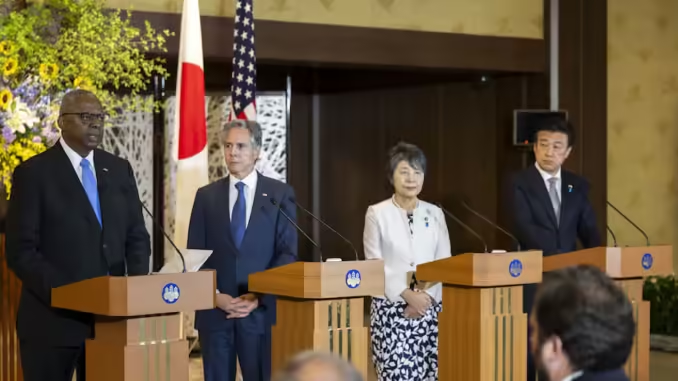
In a significant move to enhance military cooperation, the United States announced plans to convert U.S. Forces Japan into a joint force headquarters, as stated by U.S. Secretary of Defense Lloyd J. Austin III. This transformation will occur through a phased approach, reporting directly to the commander of U.S. Indo-Pacific Command.
The announcement followed a two-plus-two ministerial meeting in Tokyo, attended by Secretary Austin, Secretary of State Antony Blinken, Japan’s Minister for Foreign Affairs Yoko Kamikawa, and Japan’s Minister of Defense Minoru Kihara. Secretary Austin described the decision as a historic modernization of the alliance’s command and control structure, aimed at addressing current and future challenges.
The new joint force headquarters, led by a three-star officer, will serve as a counterpart to Japan’s Self-Defense Forces Joint Operations Command. This reorganization marks the most significant change to U.S. Forces Japan in 70 years and strengthens military ties between the two nations. It will enhance joint operations and deterrence capabilities, particularly in response to threats in the Indo-Pacific region.
The discussions also covered expanding bilateral military presence in Japan’s Southwest Islands, cooperation in cybersecurity, intelligence, surveillance, reconnaissance, cross-domain operations, and defense industrial collaboration. Notably, there were talks on co-production opportunities for Advanced Medium-Range Air-to-Air Missiles and Patriot Advanced Capability-3 Missile Segment Enhancement missiles.
A separate ministerial meeting on extended deterrence, unprecedented at this level, reaffirmed the U.S. commitment to Japan’s defense, including nuclear capabilities. The discussions addressed North Korea’s nuclear and missile programs, China’s nuclear expansion, and Russia’s arms transfers with North Korea.
Secretary Austin highlighted the success of the meetings, emphasizing the reinforcement of the U.S.-Japan alliance as a cornerstone of security and stability in the Indo-Pacific.–News Desk