
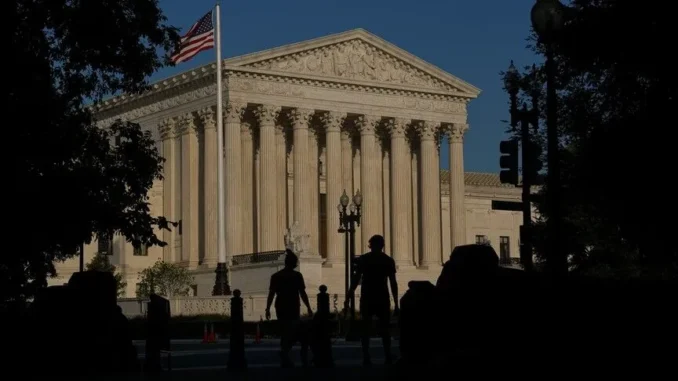
The US Supreme Court on Tuesday rejected President Donald Trump’s executive order seeking to limit birthright citizenship, reaffirming that the Constitution guarantees automatic citizenship to nearly all children born on American soil under the 14th Amendment.
In its decision in Trump v. Barbara, the court ruled that the administration’s attempt to exclude children born to undocumented immigrants and temporary visa holders from automatic citizenship violated the Constitution’s long-established interpretation of the Citizenship Clause.
Writing for the majority, Chief Justice John Roberts said the 14th Amendment’s protections apply to children born within the United States who are “subject to the jurisdiction thereof,” regardless of their parents’ immigration status. He stressed that citizenship at birth remains a fundamental constitutional right and a cornerstone of participation in American society.
“The Constitution guarantees citizenship to those born in the United States and subject to its jurisdiction,” Roberts wrote, describing citizenship as the essential “right to have rights.” He added that the framers of the 14th Amendment intended to extend that protection to every person born on US soil, a commitment the court reaffirmed in its ruling.
Roberts was joined by Justices Sonia Sotomayor, Elena Kagan, Amy Coney Barrett, and Ketanji Brown Jackson, forming a five-justice majority.
Justice Brett Kavanaugh filed a partial concurrence and partial dissent, while Justices Clarence Thomas, Samuel Alito, and Neil Gorsuch dissented from the decision.
The Trump administration had argued that granting automatic citizenship to children born to parents who entered or remained in the country unlawfully encourages illegal immigration. However, the court rejected that interpretation, preserving more than a century of constitutional precedent surrounding the Citizenship Clause.
Legal scholars have long interpreted the phrase “subject to the jurisdiction thereof” in the 14th Amendment as extending birthright citizenship to nearly everyone born in the United States, with only limited exceptions such as children of foreign diplomats.
The ruling leaves intact one of the most significant constitutional principles governing American citizenship and marks a major legal setback for the Trump administration’s immigration agenda. President Trump had not publicly commented on the decision at the time of publication.
NEWS DESK
PRESS UPDATE