
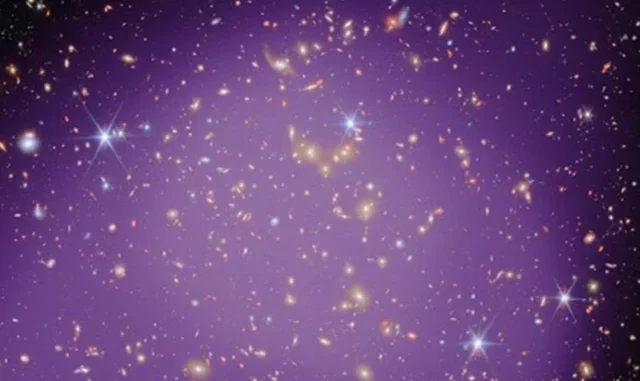
James Webb Telescope Captures Deepest Image Yet of Ancient Galaxies
The James Webb Space Telescope has captured its deepest view of the universe to date, revealing distant galaxies from the early stages of cosmic history, the European Space Agency (ESA) announced Tuesday.
The image, focused on a single target for more than 120 hours, shows a massive galaxy cluster called Abell S1063, located 4.5 billion light-years from Earth. While this cluster forms the bright center of the image, it’s the warped arcs of light surrounding it—distant galaxies magnified through gravitational lensing—that intrigue astronomers.
These arcs offer a glimpse into the Cosmic Dawn, a period shortly after the Big Bang when the universe was just a few million years old. By analyzing these ancient galaxies, scientists aim to understand how the first galaxies formed and evolved.
The ESA said the image combines nine separate exposures taken in different near-infrared wavelengths, allowing the telescope to peer deeper into the cosmos than ever before.
Since its launch in 2022, the James Webb Space Telescope has revolutionized astronomy, uncovering surprising data—such as the unexpectedly large size of early galaxies—that challenge existing theories about the universe.
NEWS DESK
PRESS UPDATE