
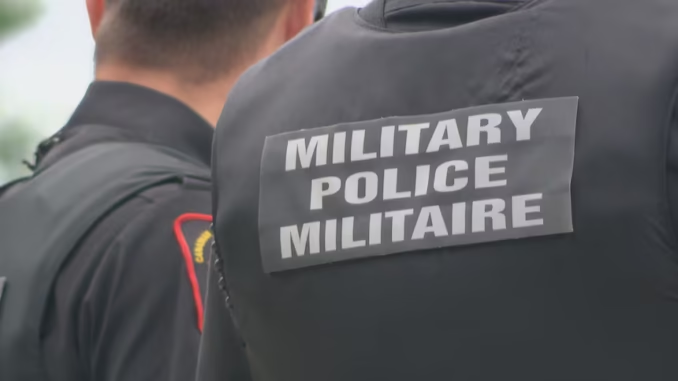
OTTAWA: New figures have revealed that Canada’s military police continued investigating the majority of sexual offence cases over the past five years, despite the federal government’s commitment to transfer such cases to civilian authorities following recommendations aimed at restoring public trust.
According to data obtained by CBC News, military police retained 595 of 879 sexual offence investigations between 2021 and 2026, while only 284 cases were referred to civilian law enforcement agencies. The findings have raised questions about the implementation of reforms introduced in response to the Canadian Armed Forces’ long-running sexual misconduct crisis.
The issue traces back to 2021, when then-defence minister Anita Anand accepted recommendations from former Supreme Court justice Louise Arbour, who had been tasked with conducting an independent review of sexual misconduct within the military. Arbour concluded that the military justice system faced significant challenges in handling sexual offence cases and recommended that such investigations be permanently transferred to civilian police and courts.
At the time, Anand publicly endorsed the recommendation and announced plans to move military sexual misconduct cases into the civilian justice system while legislative changes were being developed. The government later introduced reforms through Bill C-11, which has now formally removed the military’s authority to investigate and prosecute sexual offences.
However, newly released data suggests that during the transitional period, military police continued to oversee most investigations. Retired colonel and lawyer Michel Drapeau, who has represented victims of military misconduct, criticized the situation, arguing that the public was led to believe cases would routinely be transferred to civilian authorities.
Defence Minister David McGuinty’s office defended the government’s position, stating that Ottawa accepted Arbour’s recommendations in full. Officials said the government refrained from issuing direct orders to military law enforcement agencies out of respect for their operational independence. Instead, military justice officials developed their own guidelines for handling such cases.
Military police officials have maintained that decisions on whether to retain or transfer investigations were made using a victim-centred approach, taking into account the wishes and circumstances of complainants. Nevertheless, critics argue that the high number of cases retained by military authorities undermined the spirit of the promised reforms.
The passage of Bill C-11 is expected to eliminate future ambiguity by clearly assigning jurisdiction over sexual offence investigations to civilian law enforcement agencies. Supporters of the reforms say the change is a crucial step toward improving accountability, increasing transparency, and rebuilding confidence among victims and the broader public.
The newly disclosed figures have reignited debate over how effectively the military implemented reform commitments and whether sufficient oversight existed during the transition period.
NEWS DESK
PRESS UPDATE