
From Quadcopters to Micro-UAS: Inside the Drone Systems Used at the War Department’s Drone School
Overview of Training at JCU
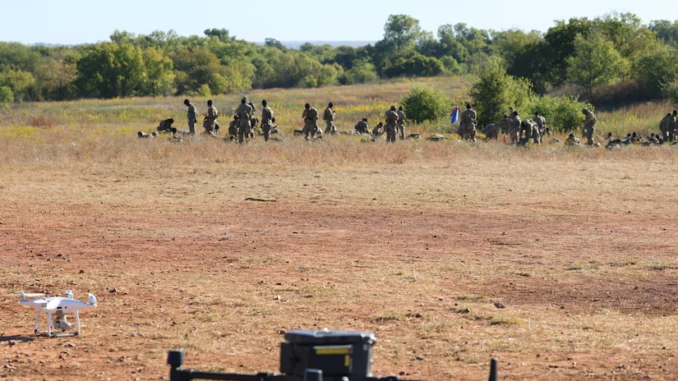
As drones become more common on modern battlefields, U.S. service members must understand the wide range of unmanned aircraft they may encounter. At the Joint Counter-Small Unmanned Aircraft Systems University (JCU) at Fort Sill, Oklahoma, students train on roughly two dozen different drone systems.
The JCU serves as the War Department’s only joint training center focused on countering small aerial threats. It teaches troops from every service branch how to operate drone equipment, build counter-UAS plans, and train others to defend military bases from hostile aircraft.
Types of UAS Used in Training
Throughout the courses, students study 24 commercial, off-the-shelf drones—from friendly “blue air” models to “red air” aircraft that mirror enemy systems. These platforms range from common quadcopters to tiny micro-UAS and custom foam drones designed to simulate real battlefield threats.
Below are highlights of several key aircraft used in training.
Black Hornet
The Black Hornet is the smallest drone at JCU. Developed under Special Operations Command, it supports close-range intelligence, surveillance, and reconnaissance missions. Troops can fly it indoors during hostage rescue situations. It includes a thermal camera and is compact enough to fit on a soldier’s utility belt.
R80D SkyRaider
Designed specifically for the War Department and other federal agencies, the R80D SkyRaider is a vertical takeoff quadcopter known for its agility. It carries multiple payloads weighing up to 7.7 pounds and includes one of the most advanced AI computing systems found in small UAS. It also operates effectively in GPS- or communications-denied areas.
WingtraOne Gen II
Regarded as one of the fastest surveillance drones in the world, the WingtraOne Gen II is a fixed-wing aircraft equipped with several cameras and a LiDAR option. It captures precise 3D images of terrain and structures, travels at about 36 mph, and performs well in strong winds.
IF 1200
The IF 1200, an electric hexacopter weighing between 21 and 55 pounds, is the school’s most aggressive small UAS. According to JCU Air Boss Jacob Cameron, the drone adapts easily to mission requirements. It supports LiDAR, radiation detection, EO/IR sensors, and delivery tasks. The IF 1200 can fly up to 70 mph, carry 35 pounds, and stay airborne for 45 minutes.
Cameron noted that despite its size, it can even perform flips and is one of the fastest and most capable drones in the school’s fleet.
Alta X
The Alta X is the JCU’s largest quadcopter and the advanced counterpart to the IF 1200. Although large, it is quieter than many other drones. Primarily used for detection missions, it can carry up to 40 pounds. The drone folds to half its size in 20 seconds and supports EO/IR, mapping, LiDAR, and various third-party payloads.
TSM-800
Produced by the Army Threat Systems Management Office, the TSM-800 is built for threat simulation. It can control a swarm of up to 150 drones from a single ground station. Each aircraft carries an 8-pound payload or three small bomblets. It operates through Wi-Fi or a private LTE network.
Super Decathlon
The “Super D” is a larger gas-powered aircraft used for detection and identification training. It supports both manual and autopilot modes and often appears in loitering munition demonstrations. If an enemy attempts to jam its signal, the drone continues its flight path without disruption. It can fly up to 70 miles and carry large payloads.
Its size makes it easy for students to spot on radar, which improves hands-on learning.
Vesper
The Vesper is a lightweight quadcopter designed for intelligence, surveillance, and reconnaissance. Weighing only 2.2 pounds, it is easy to transport and includes EO/IR cameras, low-light capabilities, and up to 50 minutes of endurance at speeds of 45 mph.
Opterra
The Opterra is a foam drone primarily used as a target aircraft. It includes multiple camera mounts and can withstand repeated hits during live-fire exercises.
Maj. Dennis “Chip” Stanford, the JCU executive officer, explained that the foam body allows most bullets to pass through harmlessly unless they strike critical components.
Other Aircraft in Use
Students also train on several additional systems, including the CarbonCub, Skywalker X8, Vector-Scorpion, Osprey, IF 800, and the JTAC24—a JCU-designed, 3D-printed target drone—among others.
NEWS DESK
PRESS UPDATE