
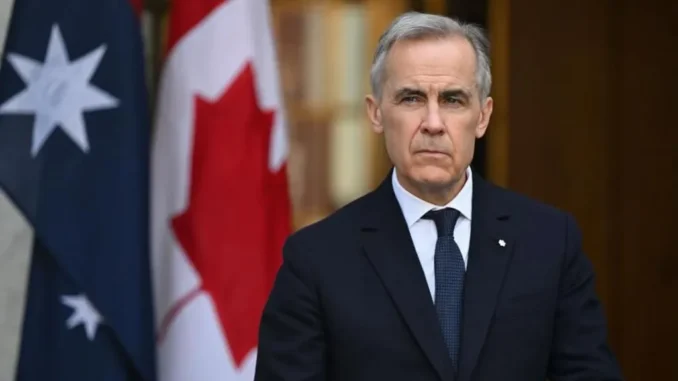
Mark Carney Faces Criticism While Balancing Canada’s Response to Iran Conflict
OTTAWA — Canadian Prime Minister Mark Carney is facing growing criticism at home as he tries to balance Canada’s position on the recent military strikes on Iran carried out by the United States and Israel.
At the same time, Canada is working to evacuate its citizens from the region while assessing the risk of becoming involved in a wider conflict.
Initial support followed by caution
When the strikes began about a week ago, Carney expressed strong support for the action. He argued that preventing Iran from developing nuclear weapons would help protect international peace and security.
However, only a few days later, the prime minister adopted a more cautious tone. He said he supported the decision “with regret,” noting that the attacks appeared inconsistent with international law.
Call for de escalation
During a meeting with Australian Prime Minister Anthony Albanese, Carney urged a rapid reduction in tensions. Both leaders called for steps to prevent the conflict from expanding further across the Middle East.
Earlier, the governments of United Kingdom, France, and Germany also addressed the situation. While they criticized Iran’s government, they simultaneously called for renewed negotiations.
Since then, those countries have also adjusted their positions. France strengthened its military presence in the region after an Iranian strike targeted one of its bases in the United Arab Emirates.
Meanwhile, the United Kingdom allowed the United States to use British military bases for defensive operations. A B‑1 Lancer bomber capable of carrying cruise missiles recently arrived in the UK.
At the same time, German Chancellor Friedrich Merz warned about the dangers of becoming involved in prolonged conflicts.
Canada leaves door open to military support
Carney has not completely ruled out military involvement. Instead, he said Canada would support its allies if such action becomes necessary and reasonable.
However, this position has sparked criticism across Canada’s political landscape.
Political criticism grows
Former foreign minister Lloyd Axworthy criticized the government in an opinion article published in the Toronto Star. He argued that Carney’s support for the strikes marked a shift from Canada’s earlier position during the 2003 Iraq War, when the country refused to join the US-led invasion.
Axworthy wrote that Canada now appears to support a military approach it previously rejected.
Similarly, Liberal Member of Parliament Will Greaves said Canada should not support unilateral military action while defending its own sovereignty.
His comments also referred to repeated remarks by US President Donald Trump about the possibility of Canada becoming the 51st US state.
Opposition leaders have also questioned the government’s approach. Some critics described Carney’s position as inconsistent and unclear.
Experts say policy remains difficult to interpret
According to Roland Paris, director of the Graduate School of Public and International Affairs at the University of Ottawa and a fellow at Chatham House, Carney’s policy has been difficult to interpret.
He said the prime minister appears to be navigating a complex diplomatic situation while balancing domestic criticism and international alliances.