
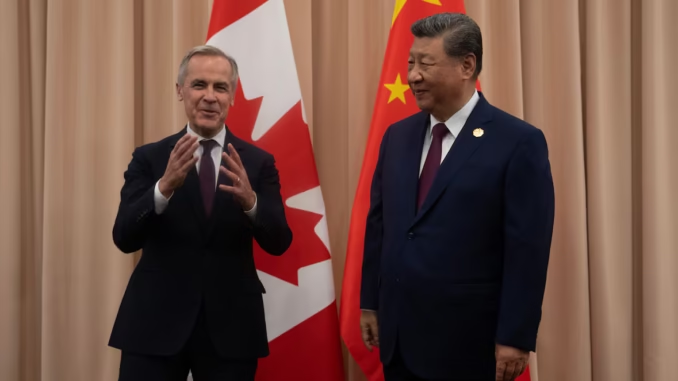
Mark Carney to Visit China After Nearly a Decade
Prime Minister Mark Carney will travel to China next week, marking the first visit by a Canadian prime minister in almost ten years, the Prime Minister’s Office confirmed on Wednesday.
The visit, scheduled from January 13 to 17, aims to strengthen dialogue between Canada and China on trade, energy, agriculture, and international security. Officials say the trip reflects renewed diplomatic engagement after years of strained relations.
A Long Pause in Diplomatic Ties
Canada last sent a prime minister to China in 2017. Relations deteriorated sharply in 2018 when Canadian authorities arrested Huawei executive Meng Wanzhou at the request of the United States on fraud-related charges.
Shortly afterward, China detained Michael Kovrig and Michael Spavor, accusing them of espionage—claims both men denied. They spent more than 1,000 days in detention before China released them, shortly after Meng returned to China.
Gradual Diplomatic Reset Under Carney
Despite previously describing China as Canada’s largest security threat during an election debate last April, Carney has since signalled a more pragmatic approach.
In September, he met Chinese Premier Li Qiang during the United Nations General Assembly. A month later, Carney held talks with President Xi Jinping at the APEC summit in Gyeongju, South Korea.
Following that meeting, Carney said relations had reached a “turning point” and emphasized the need for practical engagement. He also accepted Xi’s invitation for a future state visit, now confirmed for next week.
Trade Disputes and Tariff Pressure
Trade tensions remain central to the relationship. Canada continues to review former prime minister Justin Trudeau’s decision to impose 100 per cent tariffs on Chinese electric vehicles, alongside 25 per cent tariffs on Chinese steel and aluminum.
In response, China imposed 100 per cent tariffs on Canadian canola oil and meal, nearly 76 per cent on canola seed, and 25 per cent duties on some seafood products.
China’s ambassador to Canada, Wang Di, said in October that Beijing would remove canola tariffs if Ottawa dropped its EV levies.
Provincial Leaders Push for Trade Relief
Saskatchewan Premier Scott Moe welcomed Carney’s visit, expressing hope that it would lead to progress on canola tariffs. Manitoba Premier Wab Kinew also urged Ottawa to reconsider its EV policy.
Moe said the visit should support broader trade diversification rather than focus on a single market. He added that China’s size and population make it a necessary part of any long-term trade strategy.
Caution From Former Detainee
Former diplomat Michael Kovrig warned against making China the core of Canada’s economic diversification efforts. He argued that removing EV tariffs could weaken Canada’s negotiating position and increase long-term dependence.
Trade Figures and Future Outlook
China remains one of Canada’s largest trading partners. According to Statistics Canada, total bilateral trade reached $118.7 billion in 2024, including approximately $30 billion in Canadian exports.
China has suggested the two countries could significantly expand trade if market conditions allow. However, Canadian officials continue to stress the importance of balanced and diversified partnerships.
NEWS DESK
PRESS UPDATE