
Trump’s Battleship Proposal Raises High Stakes for the US Navy
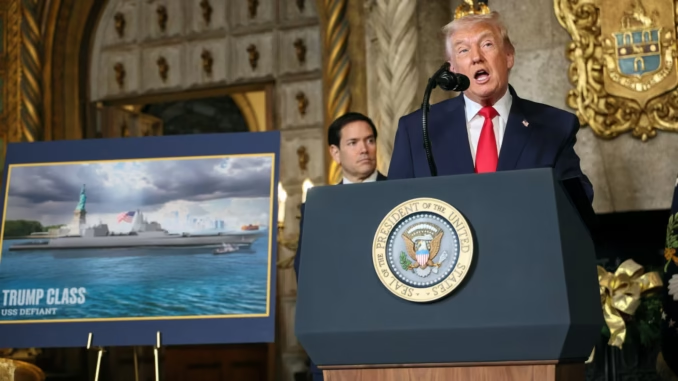
President Donald Trump’s proposal to introduce a new class of battleships carrying his name has drawn renewed attention to long-standing challenges within the US Navy’s shipbuilding program. In recent years, the Navy has struggled to deliver new warships on schedule and within budget—an issue Trump openly acknowledged during a speech at his Mar-a-Lago residence on Monday.
Speaking to supporters, Trump praised American military technology but criticized production delays. “We make the greatest equipment in the world—by far. Nobody is even close,” he said. “But we don’t produce them fast enough.” He added that he plans to meet senior US defense contractors soon to accelerate production of the proposed battleships and other weapons systems.
However, despite the ambitious announcement, the Navy may face significant obstacles. Both the construction of the vessels and the development of some planned weapon systems could prove difficult, given existing industrial and logistical constraints.
The Vision Behind the Trump Class
According to a US Navy fact sheet released on Monday, the proposed Trump-class battleships would become “the most lethal warships ever built.” The Navy envisions vessels measuring up to 880 feet in length, with a displacement ranging from 30,000 to 40,000 tons.
If built, these ships would represent the largest surface combatants constructed by the US Navy since World War II. By comparison, historic battleships such as the USS Missouri—where Japan formally surrendered in 1945—measured 887 feet long and displaced approximately 58,000 tons.
How They Compare to Today’s Fleet
Currently, the Navy’s largest surface warships are the Zumwalt-class destroyers. These modern vessels displace roughly 15,000 tons, making them significantly smaller than the proposed Trump-class battleships.
As a result, the plan signals a dramatic shift in naval design philosophy. While supporters argue the ships could restore US maritime dominance, critics warn that size, cost, and production timelines may strain an already challenged shipbuilding system.
Key Challenges Ahead
Although the proposal highlights military strength and ambition, experts caution that success will depend on execution. The Navy must overcome delays, control costs, and ensure that advanced weapons systems can integrate smoothly with the new platforms. Without these improvements, the program risks adding pressure to an already overburdened defense industry.
NEWS DESK
PRESS UPDATE