
EU Halts Approval of US Trade Deal Amid Greenland Dispute
The European Parliament has suspended the approval of a major trade agreement with the United States after renewed tensions triggered by former US President Donald Trump’s demand to take over Greenland.
The announcement came on Wednesday in Strasbourg, France, while Trump was speaking at the World Economic Forum in Davos. Lawmakers said the move reflected growing concern over escalating trade pressure and diplomatic strain between Washington and Brussels.
Trade Tensions Resurface
The suspension followed Trump’s renewed threat to impose tariffs on European countries if his demand regarding Greenland was not met. These remarks unsettled financial markets and revived fears of a fresh transatlantic trade conflict.
Later the same day, Trump claimed on social media that he had reached a “framework” agreement on Greenland’s future. He also said he would not move forward with plans to impose new tariffs on eight NATO member states.
Background of the Turnberry Deal
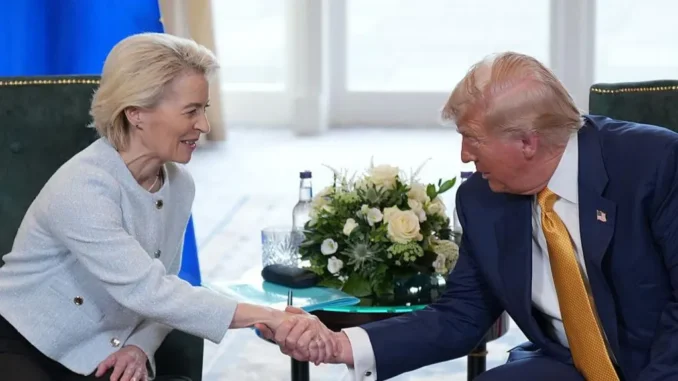
Trade relations between the US and the EU had stabilised after both sides reached an agreement in July at Trump’s Turnberry golf resort in Scotland. Under that deal, the US reduced tariffs on most European goods to 15%, down from the 30% initially proposed during Trump’s “Liberation Day” tariff campaign in April.
In return, the EU agreed to invest more in the US economy and introduce reforms expected to increase American exports. However, the agreement required formal approval from the European Parliament before it could take effect.
Parliament Suspends Legislative Work
Days after Trump renewed tariff threats over Greenland, Bernd Lange, chair of the European Parliament’s International Trade Committee, announced that lawmakers had suspended work on the two legislative proposals linked to the Turnberry deal.
He stated that Parliament would not proceed until the US returned to “cooperation rather than confrontation.” He also warned that no further progress would occur while tariff threats remained on the table.
Possible Retaliation Measures
As a result of the suspension, the EU may now move forward with retaliatory tariffs worth up to €93bn ($109bn) on American goods. The bloc had announced these measures last year in response to Trump’s earlier tariffs but delayed their implementation while negotiations continued.
Unless the EU extends the pause or approves the trade deal, these tariffs will come into force on 7 February.
Lange also raised the possibility of activating the EU’s “anti-coercion instrument,” often referred to as the “trade bazooka.” French President Emmanuel Macron has previously supported this measure.
Uncertainty After Trump’s Climbdown
Speaking to the BBC after Trump announced the “framework” agreement and stepped back from tariff threats, Lange said it was too early to judge whether the trade deal could be revived.
“We need time to understand what this so-called solution really means,” he said.
Within Brussels, officials appeared sceptical of Trump’s reversal. When asked for a reaction, one senior EU source responded with an eye-rolling emoji, suggesting limited confidence in the US president’s commitment.
Markets Remain Unfazed
Over the past year, financial markets have largely ignored Trump’s policy threats. Investors often rely on the phrase “TACO” — Trump Always Chickens Out — reflecting a belief that he frequently backs down from aggressive positions.
This perception now seems to extend into European political circles as well.
Greenland Remains Central Issue
In his Davos speech, Trump repeated his interest in acquiring Greenland from Denmark. However, he insisted he would not use force, saying he preferred negotiations. He described Greenland as strategically vital for both US and global security.
A few hours later, he announced the outline of a future agreement, though details remain unclear.
NEWS DESK
PRESS UPDATE