
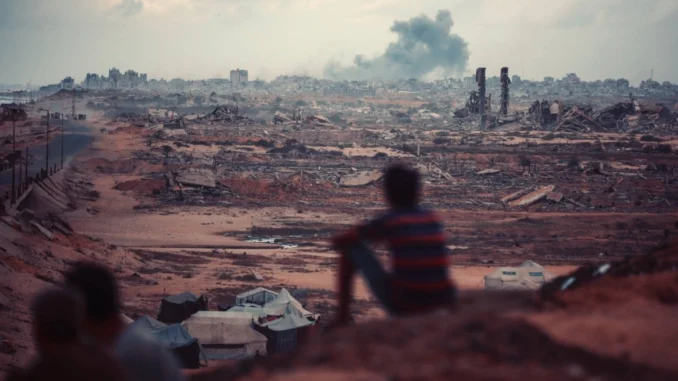
Hamas’ 2023 Attack Reshapes Middle East Power Dynamics
Since Hamas launched its attack on Israel on October 7, 2023, the Middle East has faced its most severe crisis in decades. The assault highlighted that Hamas still poses a serious threat to Israel’s security. Israel’s military response quickly triggered a wider regional conflict, reshaping the balance of power.
The latest war in the Gaza Strip created a massive humanitarian crisis, whose effects will be felt long after the fighting ends. The conflict expanded into a broader confrontation between Israel and the Iranian-backed “Axis of Resistance,” involving Lebanon, Syria, Yemen, Iran, and Qatar. Israel secured key victories, including crippling Hamas, weakening Hezbollah by eliminating its leadership, reducing Iran’s influence in the Levant, and striking Iran’s military and nuclear infrastructure.
After Israel targeted Hamas positions in Qatar in September, the United States pushed for a ceasefire in Gaza. Despite any pause in fighting, Israel aims to expand its territorial influence in the West Bank, southern Lebanon, and southwestern Syria, potentially further destabilizing neighboring regions. The Axis of Resistance has lost much of its previous power, leaving a fragmented Levant dominated by competing minority groups, including Alawites, Druze, Maronites, Shiites, and Sunnis, under Israel’s growing influence.
A Shift in Regional Balance
The pre-2023 regional balance of power has changed dramatically. Israel’s strength has grown while Iran’s influence has declined. The United States and regional Arab powers have played a limited role, mostly focusing on ending the Gaza conflict. However, even a ceasefire or prisoner exchange may not secure lasting peace. The Middle East faces a future of prolonged tension and instability.
Israel’s military actions have prioritized its own supremacy rather than fostering regional alliances or political stability. Its dominance may not guarantee long-term order and could trigger new forms of resistance, leading to continued conflict.
The U.S. Response
America’s involvement has been sporadic and reactive. Its vision for regional stability has lagged behind the changing dynamics. During former President Donald Trump’s administration, the U.S. relied on Gulf monarchies as anchors of stability. Under President Joe Biden, the strategy expanded, promoting the Abraham Accords to normalize relations between Israel and Arab states. The goal aimed to integrate regional economies through trade corridors connecting Asia and Europe, marginalizing Iran and its allies. However, the 2023 conflict has revealed the limits of this approach.
NEWS DESK
PRESS UPDATE