
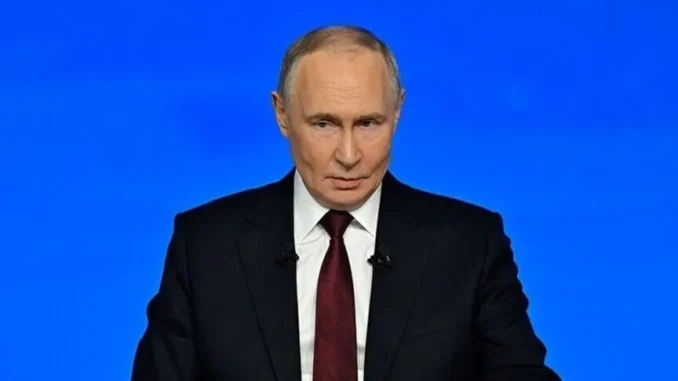
Putin Says Europe Is Damaging Its Economy by Rejecting Russian Energy
MOSCOW, October 27, 2026: Russian President Vladimir Putin has argued that Europe is harming its industrial sector and social well-being by reducing its reliance on Russian energy resources.
Addressing the eighth summit of the Gas Exporting Countries Forum (GECF) in Moscow on Tuesday, Putin warned that excluding Russia from international gas markets could have serious economic consequences. He said consumers, businesses and households in foreign markets were facing increasingly high energy costs, pointing to Europe as an example of the effects of abandoning Russian supplies and terminating long-term contracts.
Putin used a Russian proverb to describe Europe’s situation, suggesting that countries attempting to harm others could ultimately suffer similar consequences themselves.
He also highlighted growing uncertainty in the global gas industry, attributing it to escalating tensions in the Middle East, disruptions to traditional transportation routes and what he described as deliberate attacks on Russian gas pipelines supplying Europe. Restrictions on access to specialized equipment and technology have created additional challenges for the sector.
According to Putin, energy prices have increased sharply, although they could fall just as quickly. He warned that uncertainty had forced companies to postpone or cancel investment projects, raising the possibility of long-term imbalances between supply and demand.
Russia Proposes Greater Cooperation Among Gas Exporters
Putin identified disrupted gas supplies as a major challenge, noting that substantial volumes had disappeared from the market while demand remained strong. He proposed that GECF members improve transportation efficiency through reciprocal gas-swap arrangements.
He noted that liquefied natural gas (LNG) accounts for approximately half of global gas trade and offers greater flexibility because it does not rely on international pipeline networks.
Drawing a comparison with the OPEC Plus framework for managing oil markets, Putin said gas-producing countries needed stronger coordination mechanisms of their own. He proposed expanding consultations within the GECF to identify emerging risks, protect energy infrastructure and coordinate supply strategies during market disruptions.
The Russian president also emphasized the importance of long-term supply agreements to support investments in gas exploration, processing facilities, shipping capacity and LNG infrastructure. He argued that major energy projects require stable planning rather than decisions based solely on temporarily elevated prices.
Putin called for greater technological cooperation among gas-producing countries and said Russia was prepared to share expertise in deep gas extraction, Arctic LNG production and digital modelling of gas fields. He recalled that European companies had previously cooperated with Russia on Arctic projects, while Chinese partners continued to work with the country. He added that Moscow was exploring opportunities for cooperation with American partners.
Global Gas Demand Expected to Increase
Putin said GECF member countries collectively possess around 70% of the world’s natural gas reserves and account for approximately 40% of global exports. He added that natural gas represents roughly one-quarter of the global energy mix, with consumption increasing by 1.2% last year to 4.2 trillion cubic metres.
Global gas demand is projected to reach 5.5 trillion cubic metres annually by the middle of the century, while international supplies are expected to rise by about 50% to 1.7 trillion cubic metres.
Putin stated that Russia holds the world’s largest natural gas reserves and ranks second in production. He reaffirmed Moscow’s intention to remain a dependable energy supplier.
He concluded by inviting summit participants to return to Moscow next year for the 10th Russian Energy Week.
NEWS DESK
PRESS UPDATE