
Trump Outlines Expansionist US Agenda After Venezuela Operation
Washington Signals Broader Use of Power
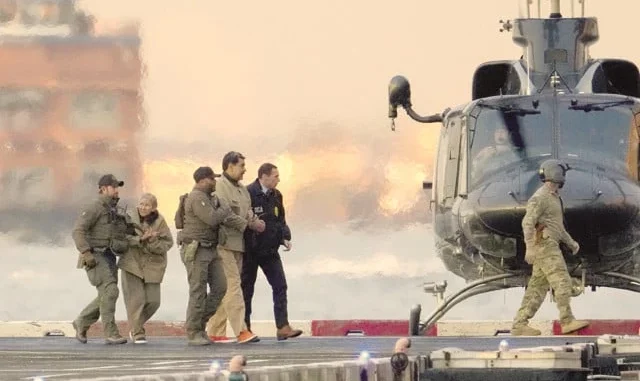
Following a dramatic US military operation that led to the capture of Venezuelan leader Nicolas Maduro, President Donald Trump on Sunday outlined a broad and confrontational vision of American foreign policy. Speaking aboard Air Force One and in media interviews, Trump declared plans to exert direct US control over Venezuela, revived his interest in annexing Greenland, and issued strong warnings to Iran and Cuba.
“We’re going to run the country” until a political transition takes place, Trump said. In an interview with The Atlantic, he added that rebuilding Venezuela and enforcing regime change would improve conditions compared to the current situation.
Trump also warned acting Venezuelan President Delcy Rodriguez, a close Maduro ally, that she would face severe consequences if she failed to comply with US demands. He said she could pay “a very big price,” possibly greater than Maduro’s.
US Position on Venezuela and Oil Access
Secretary of State Marco Rubio adopted a more measured tone, stating that the United States was targeting drug trafficking networks rather than waging war on Venezuela. He added that Washington would judge future engagement with Caracas based on cooperation.
However, Rubio confirmed that a large US naval blockade would remain in place to maintain what he described as “tremendous leverage,” particularly regarding access to Venezuela’s vast oil resources.
The operation triggered strong regional opposition. Brazil, Chile, Colombia, Mexico, Uruguay, and Spain jointly rejected the intervention. In a coordinated statement, they expressed concern over any attempt to seize foreign natural or strategic resources.
Renewed Push for Greenland
The seizure of a foreign leader also reignited concerns in Europe, particularly in Denmark and Greenland. Trump has long expressed interest in acquiring Greenland for its Arctic position and mineral wealth, and he renewed that stance on Sunday.
“We need Greenland for national security,” Trump told reporters, adding that Denmark lacked the capacity to secure it effectively. He said Washington would revisit the issue within two months.
In a separate interview, Trump repeated that Greenland was essential for US defence. The message gained further attention after Katie Miller, wife of senior Trump adviser Stephen Miller, shared an image of Greenland coloured with the US flag and captioned “SOON.”
European leaders responded swiftly. Danish Prime Minister Mette Frederiksen described the idea as “absolutely absurd” and urged the United States to stop threatening a long-standing ally.
Greenland’s Prime Minister Jens-Frederik Nielsen rejected any talk of annexation, saying, “Enough is enough.” While he criticised the online post as disrespectful, he also sought to calm public fears.
British Prime Minister Keir Starmer broke with his typically cautious approach and voiced clear support for Denmark. German Foreign Minister Johann Wadephul reaffirmed Danish sovereignty and suggested NATO discuss Greenland’s security. The European Commission echoed these concerns, stressing respect for national borders.
Warnings to Cuba and Iran
From Air Force One, Trump also delivered sharp messages to other adversaries. He claimed that Cuban security personnel died during the Venezuela operation and predicted Cuba’s collapse without Venezuelan oil support. “Cuba is ready to fall,” he said, adding that the US may not need to intervene.
Turning to Iran, where protests have entered a second week, Trump warned that any violent crackdown would prompt a strong US response. “If they start killing people,” he said, “they’re going to get hit very hard.”
International Reaction and Developments in Caracas
The past 48 hours highlight a consistent feature of Trump’s foreign policy: the open use of military and political pressure to secure immediate US interests.
UN Secretary-General Antonio Guterres raised concerns during a UN Security Council meeting on the Venezuela crisis. He stated that the US strikes on January 3 and Maduro’s arrest violated international law and the UN Charter.
In Caracas, around 2,000 Maduro supporters held demonstrations demanding the release of Maduro and his wife, Cilia Flores. The rally included pro-Maduro paramilitary groups and bikers waving Venezuelan flags.
Maduro’s son, Nicolas Maduro Guerra, suggested betrayal within his father’s inner circle in an audio message shared online, saying history would reveal the traitors.
Meanwhile, acting President Delcy Rodriguez formed a commission to seek Maduro’s release. She appointed National Assembly President Jorge Rodriguez, her brother, and Foreign Minister Yvan Gil as co-chairs. Information Minister Freddy Nanez will also serve on the panel.
NEWS DESK
PRESS UPDATE