
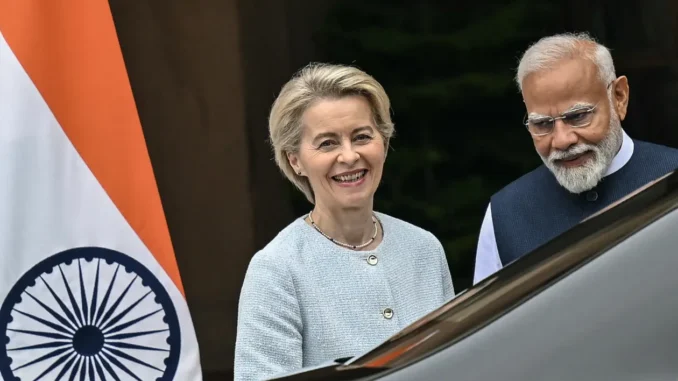
India and EU Finalise Landmark Free Trade Agreement
Modi Calls Deal Historic at India Energy Week
India and the European Union have concluded a landmark free trade agreement, ending negotiations that stretched over nearly two decades. Indian Prime Minister Narendra Modi announced the deal on Monday, calling it the “mother of all deals” during his address at India Energy Week on Tuesday.
Modi said the agreement marks a turning point in India’s trade relations with Europe and strengthens its position in global markets.
Deal Covers a Quarter of Global GDP
The European Union accounts for around 25% of global GDP and nearly one-third of world trade. Modi said the agreement will complement India’s existing trade pacts with the United Kingdom and the European Free Trade Association, expanding access to major international markets.
As a result, the deal will create a combined market of nearly two billion people at a time when global trade faces growing geopolitical pressure.
Key Sectors Set to Benefit
Modi praised teams involved across multiple industries, including textiles, gems and jewellery, leather, and footwear. He said the agreement would provide strong support to these sectors and help boost exports.
“This deal will prove highly beneficial for many industries,” Modi said in remarks delivered in Hindi and translated by CNBC.
Leaders to Reveal Details at India EU Summit
Modi and European Commission President Ursula von der Leyen are expected to issue a joint statement later in the day at the India-EU Summit in New Delhi, where officials will outline the final terms of the agreement.
Negotiators resumed talks in 2022, but progress remained slow due to sensitive areas such as agriculture and automobiles. Analysts noted that both India and the EU have historically taken protective positions on trade.
Strategic Importance Amid Global Trade Shifts
Experts say the agreement comes at a critical moment, as both India and the EU face limited options for large trade deals. According to Hosuk Lee-Makiyama, director of the European Centre for International Political Economy, the deal represents one of the most viable opportunities for both sides.
For India, the agreement offers relief as it seeks new export markets following punitive US tariffs imposed in August last year. Since then, New Delhi has accelerated efforts to diversify trade partnerships.
India Expands Trade Partnerships
This agreement marks India’s fourth major trade deal since the United States, its largest export market, imposed steep tariffs. India has also signed trade agreements with the UK, Oman, and New Zealand.
European Commission data shows that EU-India goods trade exceeded €120 billion ($140 billion) in 2024, making the EU India’s largest trading partner. India’s key exports include machinery, chemicals, base metals, mineral products, and textiles. For the year ending March 2025, bilateral goods trade reached $136 billion.
Trade Balance Still Favors US
Despite the scale of the EU deal, experts caution that it will not replace the importance of an India-US trade agreement. In 2024, India recorded a $45.8 billion trade surplus with the US, compared with $25.8 billion with the EU.
India remains the EU’s ninth-largest trading partner, accounting for 2.4% of total EU goods trade, well behind the US, China, and the UK.
NEWS DESK
PRESS UPDATE